01
What Is the Syndesmosis?
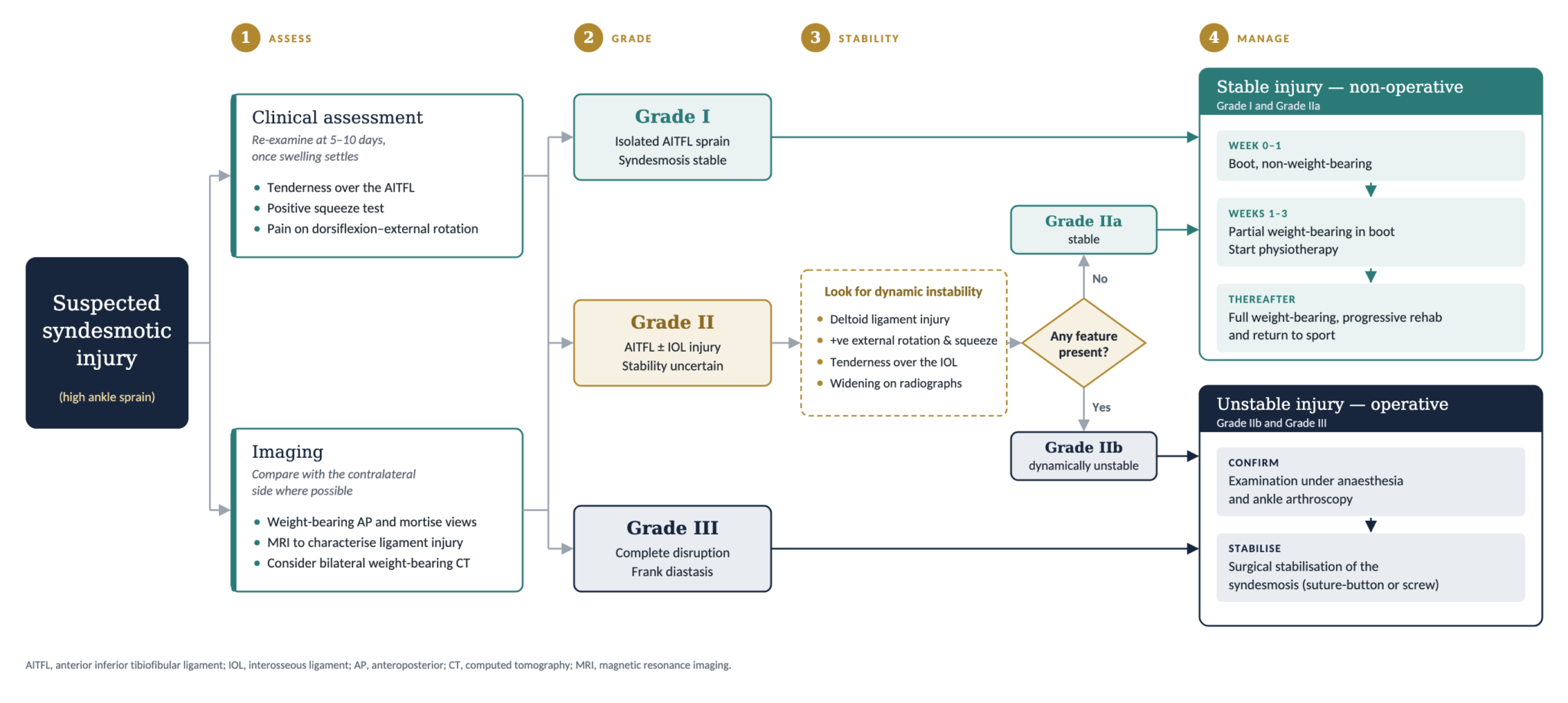
The syndesmosis is the strong fibrous joint that holds the two long bones of your lower leg — the tibia (shin bone) and the fibula (the smaller bone on the outside) — tightly together just above the ankle. It is a network of four ligaments that act like a tough strap, keeping the bones aligned every time you push off, twist or land.
The four key structures are:
- AITFL — anterior inferior tibiofibular ligament (front)
- PITFL — posterior inferior tibiofibular ligament (back)
- IOL — interosseous ligament (deep, between the bones)
- TTFL — transverse tibiofibular ligament (a deeper part of the back ligament)
This complex sits a few centimetres above the “normal” lateral ligaments that are damaged in a typical inversion (rolled-in) sprain — which is why a syndesmosis injury is often called a “high ankle sprain.” Because the syndesmosis controls how the ankle joint stays squared up under load, even a small amount of widening or rotation between the tibia and fibula can dramatically change how forces pass through the cartilage. Untreated, this is a recognised cause of long-term pain and ankle arthritis.
Why it matters: The ankle is a precision joint with very little room for error. As little as 1 mm of fibular widening can reduce the contact area on the cartilage by around 40%, which is why getting the syndesmosis right matters so much.